

Cashi in Hong Kong: Zero Fees in US Dollars, 1% in HK Dollars, and 10 Things to Check Before You Sign Up
Cashi for Hong Kong deal-hunters: whether the app takes Hong Kong, what HK dollar spending really costs, where the 3-2-1% cashback pays, a Japan trip in numbers, the US$5 invite, topping up, tap-to-pay, custody, who runs it and how to leave.
Last updated 21 November 2026

Cashi
Ad / referral links — we may earn a bonus when you sign up.
Full details & steps →Best for
Hong Kong residents with USDT or USDC lying around who book trips and shop online in US dollars, and who have checked that the Cashi app actually offers Hong Kong.
Cashi's sweet spot is narrow but real: pay in US dollars and there's no conversion fee, plus 2% back on online orders and 1% on travel bookings. Pay in Hong Kong dollars, yen or anything else and 1% goes on conversion, which wipes out the travel cashback, and shop-counter spending earns nothing at all. In our Japan trip example, US$15 of cashback shrinks to US$4 once a flight billed in HK dollars and yen shopping are counted. There's no monthly fee, the US$5 activation fee comes straight back, and the invite adds US$5 after US$50 of spending, all as card-only credit. The catches: Cashi never says whether Hong Kong is supported, so check the app first; it's virtual only and tap works on Android only; and it's not a bank, so no Deposit Protection Scheme. Worth it for dollar bookings and online orders, through our invite. For everyday HK dollar spending, don't bother.
Pros
- Zero conversion fee on anything billed in US dollars
- No monthly fee, no inactivity fee, no minimum balance, and the US$5 activation fee comes straight back as credit
- Cashback is automatic: 2% online, 1% on travel bookings, 3% on a few monthly subscriptions
- Top up USDT on Solana for a fraction of a cent, with no Cashi deposit fee
- The invite's US$5 has no deadline: any US$50 of settled purchases unlocks it
- Freeze the card in a tap and set your own daily limit, up to US$50,000
Watch-outs
- Cashi never says publicly whether Hong Kong is in; you only find out in the app
- HK dollar and yen charges cost 1%, and shop-counter spending earns no cashback
- Virtual only: tap works on Android through Google Pay, iPhone is online-only until Apple Pay arrives, and there's no published ATM option
- No deposit protection: not a bank, no HKMA or SFC licence named, and the card issuer stays anonymous
- Travel cashback maxes out at US$20 a month, and taxis, public transport, fuel and parking earn nothing
- Cashback is Spending Credit you can't cash out, and the card can only be frozen, not closed
Current related offer
Cashi offer pageAd / referral links — we may earn a bonus when you sign up.
Provider
Cashi
Cashi is run by a Hong Kong-incorporated company, yet it never says whether Hong Kong residents can sign up: it claims 100+ countries and tells you to check the app. So check Hong Kong is offered before you put in a cent. If it is, join through our invite, spend US$50 (about HK$390) on the virtual Visa and US$5 of Spending Credit lands once it settles. US dollar charges are fee-free; Hong Kong dollar ones cost 1%. The 3–2–1% cashback is capped, card-only credit. Not a bank, no deposit protection.
Requirement: US$50 (about HK$390) of settled purchases; keep US$5 in the cash balance to activate the card, which you get straight back as credit
MediumAbout 10 to 15 minutes to sign up; the ID check, first top-up and settlement take longerPayout The US$5 shows on the Reward page after your first US$50 settles; cashback goes Pending, then confirms in a few days
Verified 21 November 2026
Full claim instructions are on the Cashi offer page.
1. Can Hong Kong residents even get it?
Honest answer: Cashi doesn't say. Its help article on who can use Cashi says it's available in 100+ countries and tells you to check the app to see if yours is included. There's no list anywhere, so even though the company behind it is incorporated in Hong Kong, nothing public confirms that Hong Kong residents can sign up.
So do this first: download the app and start signing up, and it'll tell you whether registration and the card are available where you live. If Hong Kong isn't offered, stop there and don't send any money. If it is, the rest is standard: 18 or over, a valid government-issued ID for the identity check, and no US residents or US citizens, even ones living in Hong Kong.
2. What HK dollar spending really costs
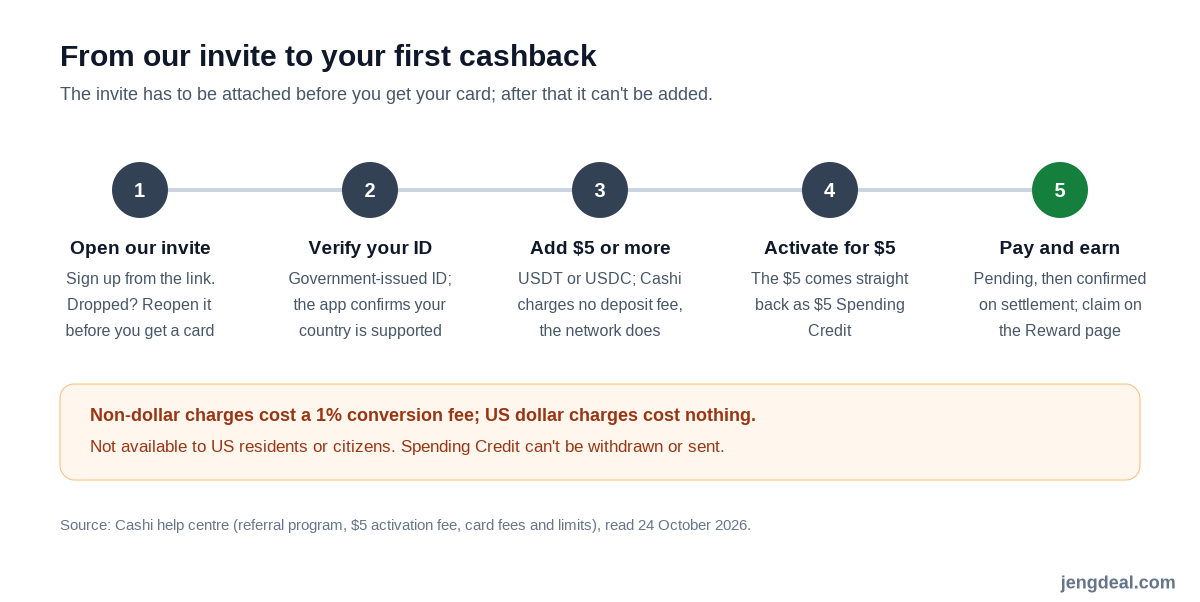
The card runs in US dollars. Anything billed in US dollars: no conversion fee. Anything billed in Hong Kong dollars, yen or any other currency gets converted, with a 1% fee on top. Cashi's fee list has no separate cross-border charge, so it's all about the currency on the bill, not where the shop is. Rule of thumb: if the checkout lets you pick US dollars, pick US dollars.
Where it hurts: shop-counter spending earns no cashback at all, so paying HK$1,000 at a local restaurant just costs you about HK$10 extra. Otherwise the fee sheet is light: no monthly fee, no inactivity fee, no minimum balance, US$5 to activate (refunded straight away as credit), US$50 for a formal dispute (asking the merchant is free), US$10 if Cashi recovers a deposit you sent on the wrong network and US$5 for a replacement card, with no credit back on that one.
3. The 3-2-1% cashback: where it pays, where it doesn't
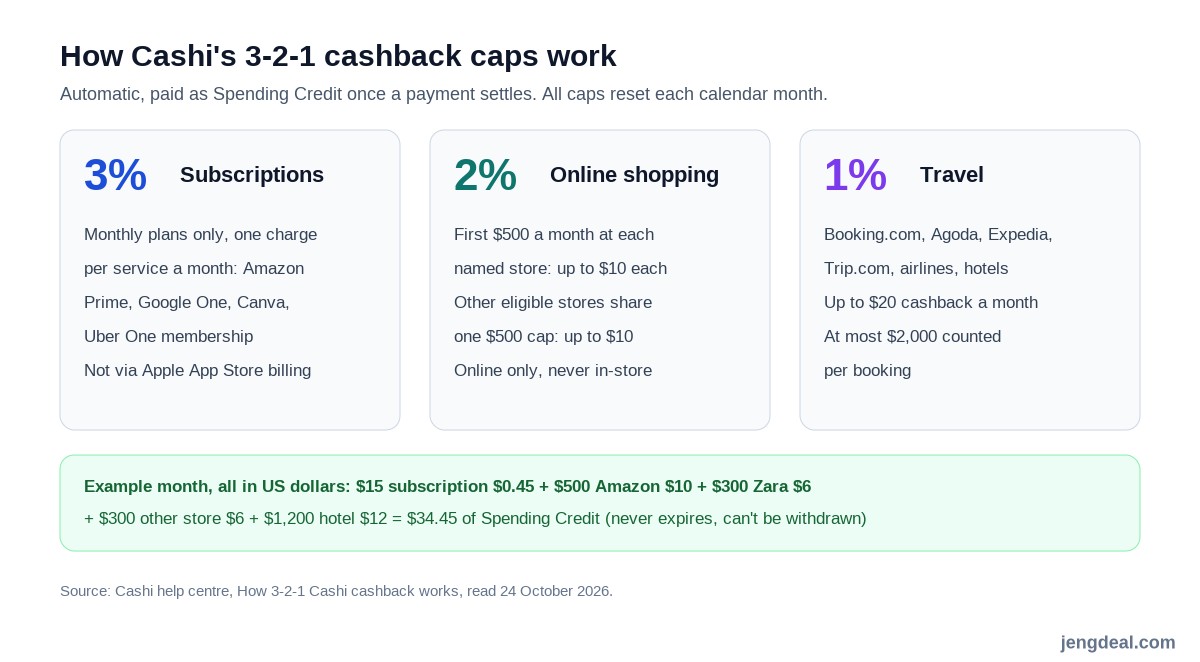
2% online: online orders only. The named stores, including Amazon, AliExpress, ASOS, eBay, H&M, IKEA, Nike, Shein, Temu and Zara, each pay 2% on your first US$500 there per calendar month, so up to US$10 a store. Every other eligible online shop shares one US$500 pot, up to US$10 in total.
1% travel: Booking.com, Agoda, Expedia, Trip.com, and airlines or hotels booked direct. It's capped at US$20 a month, only the first US$2,000 of any booking counts, and hotel charges under US$20 don't qualify. 3% subscriptions: monthly plans of Amazon Prime (Prime Video on its own too), Google One, Canva and Uber One, one charge per service a month. Yearly plans and anything billed through the Apple App Store don't count, so pay direct or through Google Play.
Zero cashback on: cash withdrawals, transfers, trading, gambling, gift cards, wallet top-ups, insurance, property, government payments, car rentals, cruises, taxis and rideshare, fuel, parking and public transport. Cashback shows as Pending straight away, confirms when the payment settles (usually a few days), and you claim it as Spending Credit on the Reward page. Refund the purchase and the cashback goes too.
4. A Japan trip, in numbers
Assume US$1 = HK$7.80 and a trip to Japan: a flight booked direct with the airline and billed HK$4,680 (US$600) in Hong Kong dollars, a hotel booked on Agoda and billed US$900 (HK$7,020) in US dollars, and the equivalent of US$500 (HK$3,900) spent in yen at shops with Google Pay on an Android phone.
Cashback: 1% on the flight is US$6 and 1% on the hotel is US$9, so US$15 (HK$117), well under the US$20 monthly cap. Fees: 1% on the HK dollar flight is US$6 and 1% on the yen shopping is US$5, so US$11 (HK$85.80). Net, you're up US$4, about HK$31.20, and the yen shopping earned nothing.
Get the airline to bill you in US dollars and the flight fee disappears: US$15 back against US$5 in fees, up US$10 (HK$78). On an iPhone you can't tap in Japanese shops at all, so pack another card for the trip either way, and remember that taxis and public transport earn nothing.
5. The invite: how to bag the US$5
Sign up through an invite on or after 1 November 2026 and Cashi drops US$5 of Spending Credit on your Reward page once your first US$50 (about HK$390) of card purchases has settled, worth about HK$39. That's on top of the US$5 activation refund everyone gets. There's no deadline, but not every purchase counts: cash withdrawals, sending money, topping up other cards or wallets, payment links and money-collection services, Cashi fees (activation included), declined payments and refunds don't, and nor does spending at any merchant that we (your inviter) or two or more of our other invitees have also paid. A refunded purchase that counted can cost you the US$5.
Timing is everything: the invite only sticks if it's on before your card is issued. Sign up from our link; if the app loses it, reopen the link before activating the card, and if Profile > Referral still shows nobody, message Cashi support before you get the card. After that it's too late, and the referrer can't be changed. This is our invite.
6. Topping up
Send USDT (Ethereum, Arbitrum, BNB Chain, Solana, Tron) or USDC (Ethereum, Arbitrum, Base, BNB Chain, Polygon, Solana) from an exchange or wallet. BTC, ETH, SOL and XRP work too (for XRP, copy the destination tag along with the address), but they stay as those coins and swing with the market. Cashi charges nothing to receive, there's no minimum, and the network fee is fractions of a cent on Solana, Tron and Polygon or anything from a few cents to a few dollars on Ethereum. Pick the same network on both ends: the wrong one can lose the money for good.
Cashi also has local-currency deposits and withdrawals (20+ currencies) and a personal USD account that takes ACH, Fedwire and SWIFT transfers, but only in some countries. Check in the app whether Hong Kong gets either before you count on it. If the USD account is there, receiving is free, while sending out costs a bank fee plus a small transfer fee, capped at US$3,000 per 7 days until you upload proof of address.
7. Android taps, iPhone shops online
The card is virtual and lives in the app. Online you type in the number, expiry and CVV like any card. In shops, it only works from an Android phone with the card added to Google Pay. Apple Pay is "on the roadmap", so iPhone users are online and in-app only for now. A physical card is promised with no date, and there's no published ATM option.
You set your own daily spending limit, up to US$50,000, and one tap on the card screen freezes it. Car-rental firms and similar merchants can put a hold above the price; Cashi takes it from your balance first and settles the difference later. If your card details leak, email [email protected] for a new card, which costs US$5.
8. Where your money sits, and what protects it
Cashi's terms say what you deposit stays yours: Cashi holds it for you, maybe in pooled wallets tracked on its own ledger or with sub-custodians, won't lend, pledge or rehypothecate it, and its creditors can't touch it. Refunds come back in USDC, whatever you paid with.
Protection, though, is zero. Hong Kong's Deposit Protection Scheme covers bank deposits, and Cashi's terms say your assets are not deposits and that no government protection or compensation scheme covers them, in any jurisdiction. USDT and USDC aim to stay at US$1, but that's down to their issuers, not Cashi. Cashi does pay an Asset reward of 2% a year on up to US$100,000 of balance (Spending Credit doesn't count), but it lands weekly as card-only Spending Credit, and the terms call it a promotional reward, not interest, that Cashi can change or end any time. Keep in it only what you'll spend in the next few weeks.
9. Who's actually behind it
You sign with Cashi Ltd., incorporated in Hong Kong. Its terms (effective 3 November 2026) run under Hong Kong law, with disputes sent to arbitration at the Hong Kong International Arbitration Centre. Home turf, legally speaking.
But a Hong Kong company isn't a Hong Kong licence. The terms name no HKMA or SFC licence; the only regulated affiliate is GBP Payments Corp., a Canadian money services business registered with FINTRAC, which is an anti-money-laundering registration, not a bank licence. Cashi calls itself "technology services only", and the Visa card comes from a card-issuing partner it never names. The terms also let Cashi restrict or pull the service in any jurisdiction at any time.
10. What users say, and how to leave
On 24 October 2026: 2.7 stars from 133 reviews on Google Play (5,000+ downloads) and 4.3 from just 6 ratings on the US App Store. Common gripes: deposits slow to show up, a first payment that failed and then worked on a retry, and support that could be quicker. Fans like the easy setup and simple card controls. It's young, so test it with a small amount.
There's no close button yet, only freeze. To leave, spend your Spending Credit (it can't be withdrawn or sent), then move your stablecoins out, paying only the network fee. If Cashi suspends or shuts your account, the terms promise help withdrawing what's left only "where technically and legally feasible".
Verdict: who should grab it, who should skip it
Grab it if the app offers Hong Kong, you already hold USDT or USDC, and you book trips and shop online in US dollars. Sign up through our invite before the card is issued, start small and always pick US dollar billing.
Skip it if you're a US citizen, want deposit protection, a physical card, ATM cash or Apple Pay, or mostly pay in Hong Kong dollars at the counter, where you'd pay 1% for nothing. And don't swap your HK dollars into stablecoins just to chase a few dollars of credit.
FAQ
- Can I sign up as a Hong Kong resident?
- Only if the app offers Hong Kong when you start signing up. Cashi says 100+ countries but publishes no list, so check before you send any money.
- How much do I lose paying in HK dollars?
- 1% on top of the exchange rate, so about HK$10 on every HK$1,000. US dollar bills cost nothing extra, and there's no separate cross-border fee.
- Is Cashi licensed or deposit-protected in Hong Kong?
- No. The company is incorporated in Hong Kong, but the terms name no HKMA or SFC licence, and the Deposit Protection Scheme doesn't cover your balance.
- How do I get the US$5?
- Sign up from our invite before your card is issued, then spend US$50 (about HK$390). Once it settles, claim the US$5 (about HK$39) on the Reward page.
- Will it work on a Japan trip?
- Online bookings, yes, from any phone. In Japanese shops only with Android and Google Pay, and every yen charge costs 1% with no cashback. No ATM option is published.
- Can I cash out the cashback?
- No. It's Spending Credit: it never expires, but it only pays for card purchases.
- Is there a monthly fee?
- No monthly fee, no inactivity fee and no minimum balance. The US$5 activation fee comes straight back as Spending Credit.
Related offers

Provider
Plasma One
Plasma One blocks Mainland China, not Hong Kong, and Rain issues the card. Code GQUIDS gets you straight in plus two Spend Bonuses in Spending Credit (spend-only, no cash-out): US$10 after US$100 at 2+ merchants in 14 days, US$200 after US$10,000 in 60 days. Free Standard pays 1% on your first US$500 a month, then 0.1%, weekly in XPL. Heads-up: Hong Kong dollar spending costs 1% FX on Standard.
Requirement: US$100 at 2+ merchants in 14 days for US$10; US$10,000 in 60 days for US$200
Medium10 to 20 minutes with ID and address checksPayout Cashback weekly in XPL; bonuses as Spending Credit you can only spend
Verified 22 November 2026

Provider
Startale
Startale's card comes from Rain's Third National, and Rain blocks Mainland China, not Hong Kong. There's no country list; Startale checks you at Rain's ID step. Join the Startale App with KNEJGM36 to grab a free spot in the queue. Virtual cards have gone out in waves by rank since 2 November 2026. No welcome bonus. You get 1% back in USDSC, but non-USD spending can cost up to 1.5% FX plus up to 1.5% cross-border.
Requirement: Free to queue; you'll need USDSC once you're in
Easy5 minutes to queue; about 5 minutes to apply once invited, up to 5 business days of reviewPayout Invites go out in waves by rank; 1% cashback in USDSC on settled purchases
Verified 20 November 2026

Provider
Solid
Solid lists Hong Kong for its card, and the free virtual Visa now comes from Wirex. Sign up with 2SS2K, then within 30 days verify, switch on the card and spend US$150 at 3+ shops (US$10+ each) for US$10 in card credit. Hit US$5,000 within 90 days and another US$50 drops in. The credit only works on Solid card spending, so you can't cash it out. Paying in Hong Kong dollars costs 1.5% FX baked into the rate.
Requirement: 30 days: verify, activate, US$150 at 3+ shops (US$10+ each) for US$10; US$5,000 in 90 days for US$50 more
Medium15 to 30 minutes to set up; the spending takes a bit longerPayout Card credit lands when you hit each target, after up to 14 days of review
Verified 22 November 2026