

Is StashAway Hong Kong worth opening? 0.8% fees, a HK$10,000 first deposit and 6 months fee-free on HK$50,000: 10 things to know before you sign up
StashAway Hong Kong from top to bottom: the licence, where your money actually sits, picking a portfolio, the management fee and the hidden costs, 30% US dividend tax, what the invite offer really saves you and how long withdrawals take, all in one go.
Last updated 12 October 2026

StashAway Hong Kong
Ad / referral links — we may earn a bonus when you sign up.
Full details & steps →Best for
Hongkongers who want to invest for the long haul, can't be bothered picking stocks, can put in HK$10,000 in one go to start, and can stomach investments going up and down.
StashAway Hong Kong is SFC-licensed, and your money sits in Citibank trust accounts, kept apart from the company's own cash; there's plenty of choice too, from auto-managed portfolios and BlackRock to build-your-own ETFs and short-term US Treasuries. But the management fee on the first HK$150,000 is 0.8% a year, plus roughly 0.2% in ETF fees and an HKD conversion fee, so it isn't cheap for small amounts. The invite offer waives management fees on up to HK$50,000 for 6 months, which works out to about HK$200 at most. Treat it as a nice little extra when you open an account, not the reason to open one.
Pros
- SFC-licensed (BQE542), with Types 1, 4 and 9 all covered
- Your money sits in Citibank trust accounts, kept apart from the company's
- Loads of portfolios: auto-managed, BlackRock, ESG, thematic, build-your-own ETFs, US Treasuries
- No account-opening fee, no exit fee, and it covers rebalancing and trading costs
- No lock-up, and you can pause and restart monthly top-ups any time
- Quick WhatsApp and phone support, rated 4.6 on the App Store (Hong Kong)
Watch-outs
- Your first deposit has to be at least HK$10,000 (or US$1,300)
- 0.8% a year on the first HK$150,000, so small amounts aren't cheap
- Paying in or taking money out in HKD costs 0.10% each way to convert
- US dividends get 30% tax taken off
- Withdrawals take 2 to 4 working days, and taking out more than 90% counts as taking it all
- Not a bank deposit, no deposit protection, and you can lose money
Current related offer
StashAway Hong Kong offer pageAd / referral links — we may earn a bonus when you sign up.
Provider
StashAway Hong Kong
Fancy some lazy investing? Sign up for StashAway Hong Kong through this invite link and, within 30 days, put in at least HK$10,000 (or US$1,300) from a Hong Kong bank account in your own name: you then pay no management fees for 6 months on up to HK$50,000 in your investment portfolios, which saves about HK$200 at most at the 0.8% rate. Let's be clear: it's a fee waiver, not cash, and ETF fees and the HKD conversion fee still apply; your Cash Yield balance doesn't count toward the cap. You need to be 18+ with no existing StashAway account, and US citizens can't sign up. StashAway Hong Kong Limited is licensed by the SFC (CE No. BQE542). Investing involves risk; not investment advice.
Requirement: First deposit of at least HK$10,000 (or US$1,300) within 30 days of signing up; the waiver covers up to HK$50,000 in portfolios for 6 months
MediumSign up, then fund within 30 days; deposits are usually invested within 2-3 working daysPayout Waiver applies once you qualify (sign up via the link, fund within 30 days); StashAway does not publish the exact start date
Verified 13 October 2026
Full claim instructions are on the StashAway Hong Kong offer page.
1. Is it licensed? Where does your money sit?
StashAway Hong Kong is run by StashAway Hong Kong Limited, an SFC-licensed corporation with CE number BQE542. Since 3 February 2021 it has held licences for Type 1 (dealing in securities), Type 4 (advising on securities) and Type 9 (asset management), and the SFC register lists one licence condition: under Type 9, it can't carry on business involving the discretionary management of collective investment schemes.
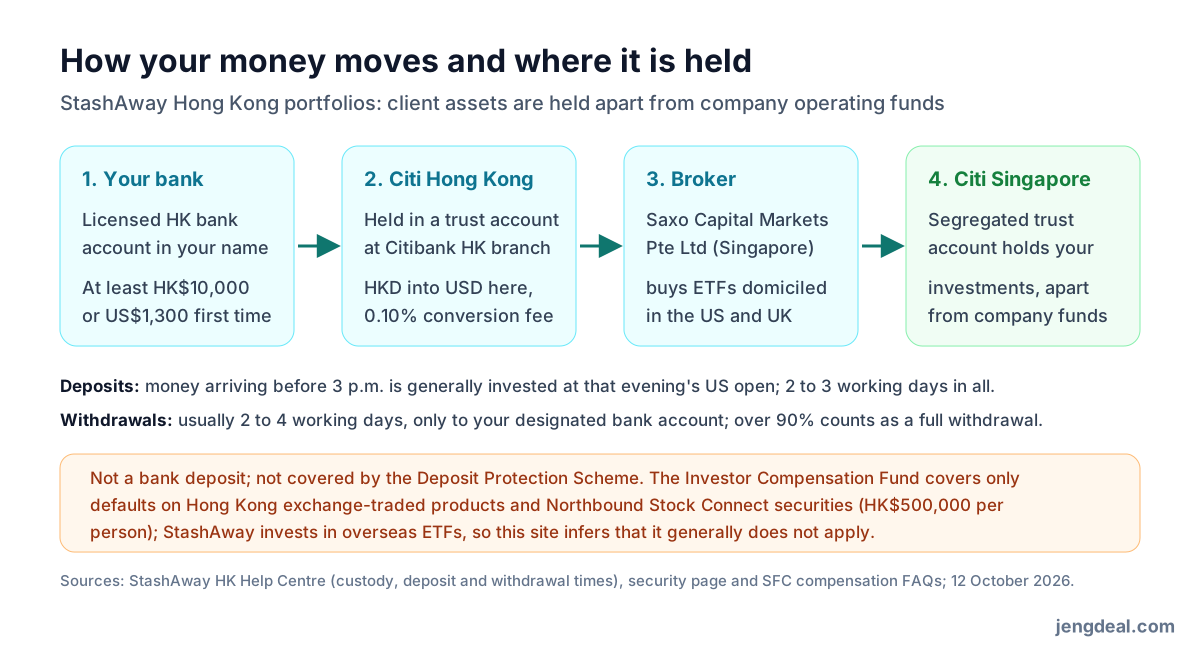
How does the money move? You transfer from a Hong Kong bank account in your own name, and the money lands first in a trust account at Citibank's Hong Kong branch, where your HKD gets converted into USD. It then goes to Saxo Capital Markets Pte Ltd, a broker in Singapore, which buys the ETFs for you; what it buys is held in a segregated trust account at Citibank's Singapore branch, kept apart from StashAway's own money. Logging in on a new device or changing your details needs two-factor authentication.
Let's be clear: it's not a bank, your money isn't a deposit, and there's no deposit protection. The SFC's Investor Compensation Fund only covers defaults involving products traded on the Hong Kong stock exchange (and mainland securities bought through Stock Connect northbound), up to HK$500,000 per person; StashAway buys ETFs registered in the US and the UK, so our reading is that the fund generally won't cover you, though StashAway itself doesn't say so.
2. What do you need to open an account? HK$10,000 minimum first deposit
You can open one if you're 18 or over and have a Hong Kong bank account in your own name; US citizens can't sign up for now. Hong Kong permanent residents need their ID card plus proof of address from the last three months (a utility bill, phone bill, or credit card or bank statement all work); non-permanent residents need a passport valid for at least six months, plus proof of address. If you work at an SFC-licensed company, you need your employer's OK, and StashAway can give you a signed discretionary account confirmation letter for your compliance team.
The thing most people miss: your first deposit has to be at least HK$10,000 or US$1,300, because the rules say your bank account has to be verified. After that there's no minimum balance, you can pay in any amount, and you can pause monthly top-ups for a month or two and restart them with no penalty. The money has to come from a licensed Hong Kong bank; transfers from other non-bank institutions may get bounced back, and everything goes through anti-money-laundering checks.
You can sign up in the app or on the website, and along the way you do a financial assessment and set up two-factor authentication. If your money reaches the Citibank trust account before noon on a working day, it shows up in your account the same day; if it arrives before 3pm, it's usually invested when the US market opens that night and shows the next working day. The whole thing usually takes 2 to 3 working days.
3. What portfolios can you pick?
The headline product is General Investing powered by StashAway, which uses its own ERAA economic-cycle framework to spread your money across global ETFs, with 12 risk levels. Then there's General Investing powered by BlackRock®, where BlackRock gives the allocation advice and StashAway handles the trading and service: it comes in 4 stock-bond mixes (20-80 up to 100-0), uses 30-odd ETFs and gets reoptimised 4 to 6 times a year.
Also on the menu: Responsible Investing, which picks ETFs with high ESG scores; Flexible Portfolios, where you build your own from 70-odd ETFs; Thematic Portfolios, which bet on themes like tech, healthcare and the environment, balanced with other assets to keep risk in check; and the USD Cash Yield Portfolio, which buys a 0 to 3 month US Treasury fund. That fund is run by J.P. Morgan Asset Management, and its yield to maturity was 4% a year as of 23 September 2026; that's the fund manager's figure, and it doesn't mean you'll get that in future.
Alternatives like private credit, private equity, private infrastructure and hedge funds are for professional investors only.
4. How to read the risk index, and why the assessment might lock you in
The StashAway Risk Index uses 99% value at risk: a portfolio with a 10% index has a 99% chance of losing no more than 10% in a year. Put in HK$100,000 and there's a 99% chance you lose no more than HK$10,000 in a year, but still a 1% chance you lose more than that.
The 9 core portfolios have risk indexes from 6.5% to 22%, and the 3 higher-risk portfolios from 26% to 36%. Before you open an account you do a financial and investment knowledge assessment, and if you don't score high enough, the system may only let you pick core portfolios. Take the past returns on the website with a pinch of salt: past performance doesn't predict the future.
5. Management fees start at 0.8%, and only get cheaper the more you put in
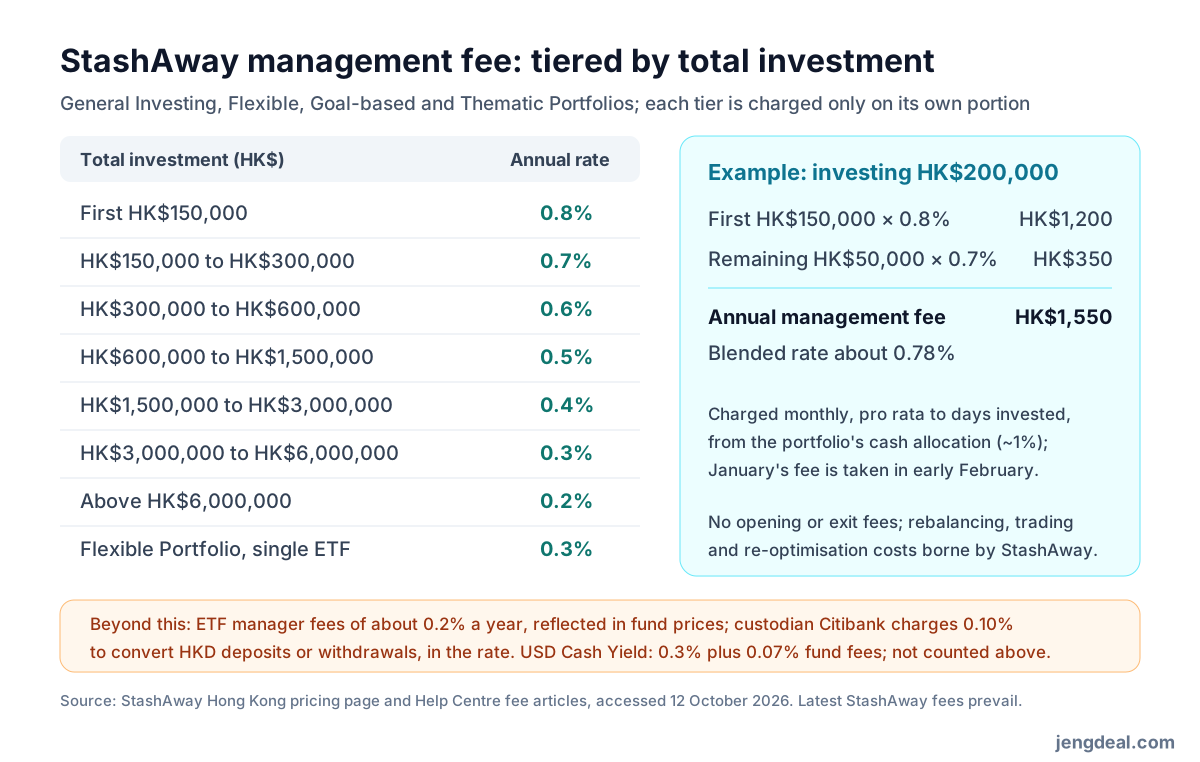
The management fee is tiered: 0.8% a year on the first HK$150,000, 0.7% on the slice from HK$150,000 to HK$300,000, 0.6% from HK$300,000 to HK$600,000, 0.5% from HK$600,000 to HK$1,500,000, 0.4% from HK$1,500,000 to HK$3,000,000, 0.3% from HK$3,000,000 to HK$6,000,000, and 0.2% above HK$6,000,000. Flexible Portfolios holding just one ETF pay a flat 0.3%.
Let's do the maths: put in HK$200,000 and the yearly management fee = HK$1,200 + HK$350 = HK$1,550, or about 0.78%. Fees are charged for the days you're invested, collected once a month, and taken from the roughly 1% cash slice in your portfolio; January's fee, for example, comes out in the first week of February. Opening, leaving, rebalancing and trading are all free, and so are withdrawals and moving money between portfolios.
6. The hidden costs beyond the management fee
First, the ETF fund managers charge their own fees: the pricing page says about 0.2% a year (the Help Centre says 0.15% to 0.25% on average), already baked into the fund prices. Second, pay in or take money out in HKD and the custodian bank, Citibank, charges 0.10% to convert, built into the exchange rate; pay in USD and there's nothing to convert, but your own bank may charge a fee.
Third, dividends from US-listed securities have 30% withholding tax taken off at source, whichever broker you buy through; the rest is reinvested automatically, and what you see in your transaction history is already after tax. StashAway says it picks ETFs looking at withholding tax, expense ratios, tracking error and bid-ask spreads together, and the ETFs it buys include ones registered in the US and the UK.
The USD Cash Yield fund is registered in Ireland and UCITS-compliant, so no US withholding tax; but it charges its own management fee of 0.3% a year plus 0.07% in fund fees, paying in HKD still costs 0.10% to convert, and its balance doesn't count towards the total used for the tiered fees.
7. How do you get the invite offer?
Open an account through our invite link and you get 6 months of management fees waived on up to HK$50,000 of portfolio assets. The referral programme FAQ says you need to: have no StashAway account right now; sign up through an invite link; fund your account within 30 days of signing up; and the referrer's own account has to be funded too (ours is). Since the first deposit is at least HK$10,000 (or US$1,300), that means putting in at least that much within 30 days.
A few things StashAway hasn't published, and we can't verify: which day the 6 months start from; how the HK$50,000 cap converts when your assets are held in USD; whether USD Cash Yield and single-ETF portfolios are covered; and whether you count as an existing customer if you had an account before and closed it, or have a StashAway account in another country. There's no separate terms document and no stated end date, so whatever StashAway says at the time is what counts.
This is our invite link. Under the programme, your full name is shown to the referrer so they can track the invite; each referrer can invite up to 10 people.
8. Six months without management fees: how much do you actually save?
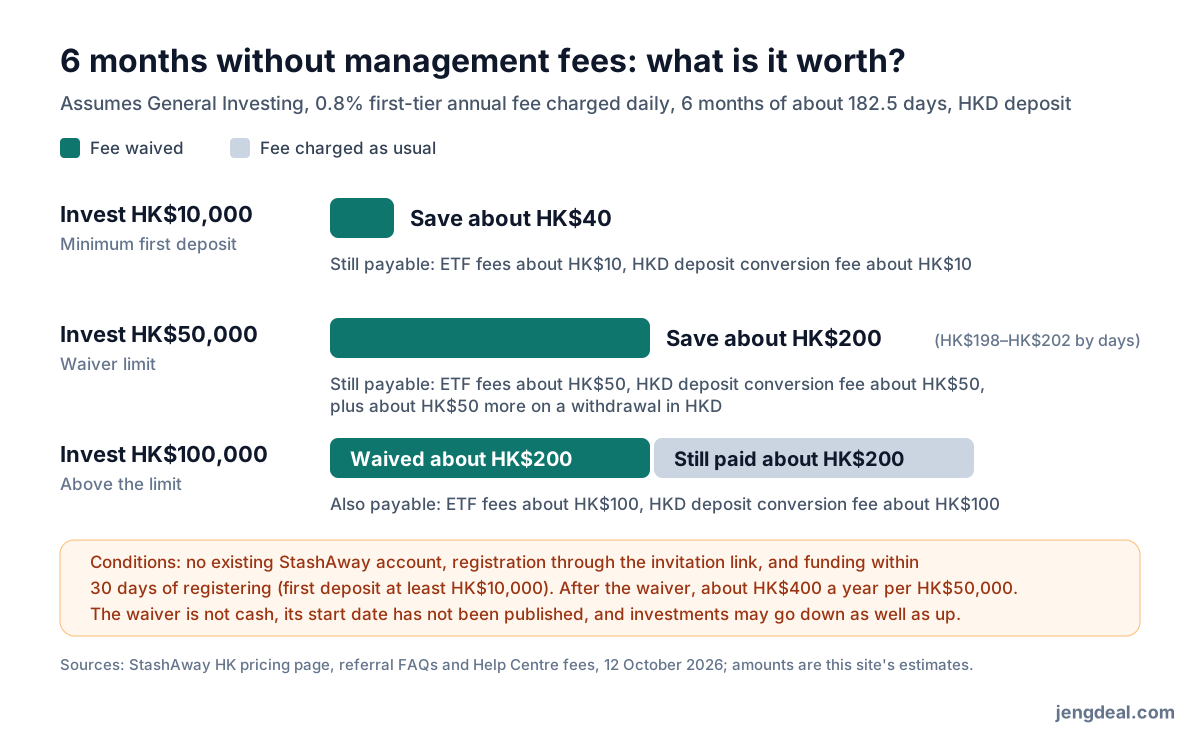
Assuming a General Investing portfolio, paying in HKD, the first-tier fee of 0.8% a year and about 182.5 days in six months: put in HK$10,000 and you save about HK$40 over six months; put in HK$50,000 (the cap) and you save about HK$200, between HK$198 and HK$202 depending on the exact number of days; put in HK$100,000 and you still save about HK$200, while the other HK$50,000 pays roughly HK$200 in management fees as normal.
ETF fees and conversion fees aren't covered: on HK$50,000, six months of ETF fees come to about HK$50, the HKD conversion fee on the way in about HK$50, and another HK$50 or so when you take it out in HKD later. Once the six months are up, management fees run about HK$400 a year for every HK$50,000. So this offer is a nice little extra, not a reason to sign up; it's not cash either, and the investments themselves go up and down.
9. Want your money out? How long is the wait?
There's no lock-up: take out part of your money or close your account whenever you like. Withdrawals are free, but taking money out in HKD still costs 0.10% to convert. StashAway has to sell during US trading hours; requests submitted before 6pm are usually processed that night, and the money usually reaches your bank account in 2 to 4 working days.
Two things to watch: take out more than 90% of a portfolio in one go and it's treated as taking the lot, because they need room for market swings; and the money only goes back to the designated bank account in your name that you used for your first deposit (over HK$10,000).
StashAway only says you can close your account any time, and we couldn't find the detailed steps, so you'll need customer service: email [email protected], WhatsApp 9862 2676 or call 5803 7274, Monday to Friday, 9am to 6pm (closed on public holidays). To complain, email [email protected]: they confirm in writing within 2 working days and give a final reply within 20 working days, or explain in writing why it's delayed and when you'll hear back, and tell you that you can take it to an approved dispute resolution scheme.
10. What do users say?
On 12 October 2026, the StashAway app scored 4.6 on the App Store (Hong Kong) (111 ratings), with a new version out on 8 October; on Google Play it scored 4.2 (6,410 ratings, over a million downloads), but that page is shared across markets and most reviews come from Singapore and Malaysia. There aren't many Hong Kong reviews, so take what follows as a rough picture.
The praise is mostly about the simple interface, how easy it is for beginners, and quick WhatsApp and phone support. The main gripes: the 0.8% management fee feels expensive; sign-up has had problems, like a user in 2022 saying the registration form wouldn't accept their Chinese name; in 2024 someone said it was hard to find a real person to help set up monthly top-ups; and users in other markets say deposits were slow to match or credit, and that you have to leave the app to pay in.
Who should go for it, and who should skip it
Go for it: Hongkongers who want to invest for the long haul, can't be bothered picking stocks and can put in HK$10,000 in one go to start; people who want a short-term US Treasury portfolio for spare US dollars; and new customers who already want StashAway and can grab six months without management fees while they're at it.
Skip it: if you're a US citizen or don't have a Hong Kong bank account in your own name; you only have a few thousand dollars to try it out and 0.8% bugs you; you might need the money soon and can't stomach a drop in value; or you want to trade individual stocks yourself, or need deposit protection.
FAQ
- What's the least I can put in?
- Your first deposit has to be at least HK$10,000 or US$1,300; after that there's no minimum balance and you can pay in any amount.
- Is the invite offer cash?
- No, it's six months of management fees waived on up to HK$50,000, which at 0.8% saves you about HK$200 at most.
- How do I get six months without management fees?
- Have no StashAway account right now, sign up through our invite link and fund your account within 30 days of signing up, with at least HK$10,000 or US$1,300 the first time.
- When do the six months start?
- StashAway hasn't said and we can't verify it, so go by what the app shows.
- Is my money protected like a deposit?
- No, it's not a bank. Your assets sit in Citibank trust accounts, kept apart from the company's money, but the investments themselves can lose money.
- How long do withdrawals take?
- Usually 2 to 4 working days, and the money only goes back to the designated bank account in your name; take out more than 90% in one go and it counts as taking it all.
- Do I pay tax on US dividends?
- Yes, 30% is taken off at source on dividends from US-listed securities, and the rest is reinvested automatically. The USD Cash Yield fund doesn't pay this tax.