

Is Improv Arena Worth It? 10 Things to Know Before Reading Cantonese Lines for US Dollars
Improv Arena pays up to US$35 (about HK$272) an hour for Cantonese reads, but only for accepted audio, and your voice gets licensed to AI companies. Who can join, what mic you need, what you'll actually make, cashing out and the ban risk, all in one place.
Last updated 27 October 2026

Best for
Native Cantonese speakers living in Hong Kong with a USB mic and a quiet room at home, who want a bit of US-dollar pocket money in spare moments and don't mind AI companies training on and cloning their voice.
Straight up: Improv Arena does pay, but US$35 (about HK$272) an hour is a ceiling, and it's an hour of accepted audio. Twenty accepted minutes, that's 80 clean 15-second takes, is worth about US$11.67 (about HK$91). Reading prompts, setting up, redos and failed takes pay zero, so your real hourly rate at the desk is a lot lower. The bigger price is your voice: before your first coin, you agree that Luvu, Inc. can license or sell your recordings, voiceprint, age, gender and rough location to AI companies for training, synthetic voices and voice cloning, with no take-backs. No sign-up bonus either. If you're fine with all that, three rules: cash out the moment you pass US$3 to US$5 to check payment works, record solo on one account, and don't let a big balance pile up.
Pros
- No fee, no deposit, no acting chops: read a few lines at home whenever
- A clear Cantonese ceiling: up to US$35 (about HK$272) per accepted hour
- Cash out from just US$3 to US$5, via Tremendous to PayPal or a gift card
- Climb the leagues for 15%, 30% or 50% extra on every take
- Traditional Chinese interface, and every take is scored on the spot
- Run by US app maker Luvu, Inc.; TinyStage sits at 4.3 from about 15,700 Google Play ratings
Watch-outs
- To earn, you license your voice, voiceprint, age, gender and location to AI companies, voice cloning included
- Only accepted audio pays; prep, redos and failed takes are worth nothing
- The Cantonese role wants a USB or studio mic on a stand; without one you're on the lower standard rate
- Recent App Store reviews: balances frozen over "multiple voices", takes that paid nothing, support that ghosts you
- Recording time is capped, and some users say the tasks dry up
- Paid in US dollars, so PayPal's exchange spread bites when you convert to HKD
Current related offer
Improv Arena offer pageAd / referral links — we may earn a bonus when you sign up.
Provider
Improv Arena
Native Cantonese speaker living in Hong Kong? Sign up with code 55PNHS and Improv Arena pays you in US dollars to read short script lines, up to US$35 (about HK$272) per hour of audio that passes. No sign-up bonus, and the catch is real: your voice gets licensed to AI companies, voice cloning included.
Requirement: No spending or deposit. You need to be 18+, a native Cantonese speaker living in Hong Kong, with a quiet room and a USB or studio mic on a stand
MediumAbout 10 minutes to sign up, including a 3-minute audition; each scene is about 15 secondsPayout Takes are scored instantly. Cash out once you pass the in-app minimum (US$3–5 right now); after approval, Tremendous emails a link to grab your US dollars via PayPal or a gift card.
Verified 27 October 2026
Full claim instructions are on the Improv Arena offer page.
1. What it is: TinyStage on the web
Improv Arena (improvarena.com) pays native speakers to record short script lines in their own language. It's the web version of TinyStage: Voice Act Rewards, an iPhone and Android app that launched in June 2026; both share one backend and one set of terms, and both belong to US company Luvu, Inc. (based in Pittsburgh, also behind the Luvu home-workout app). Already on TinyStage? Then you cash out in the TinyStage app.
The main gig is "Read scripts": a line of about 15 seconds pops up with a direction like "angry and fed up", you record it, and it's scored right away. Side gigs: rating other people's takes and transcribing clips word for word (both listed at US$20 an hour), plus short voice chats with other users. It's dressed up as a game, but Luvu's terms are blunt about the business: it collects voice data and licenses or sells it to AI companies, and your coins are payment for that data.
2. How the pay works: only accepted audio counts
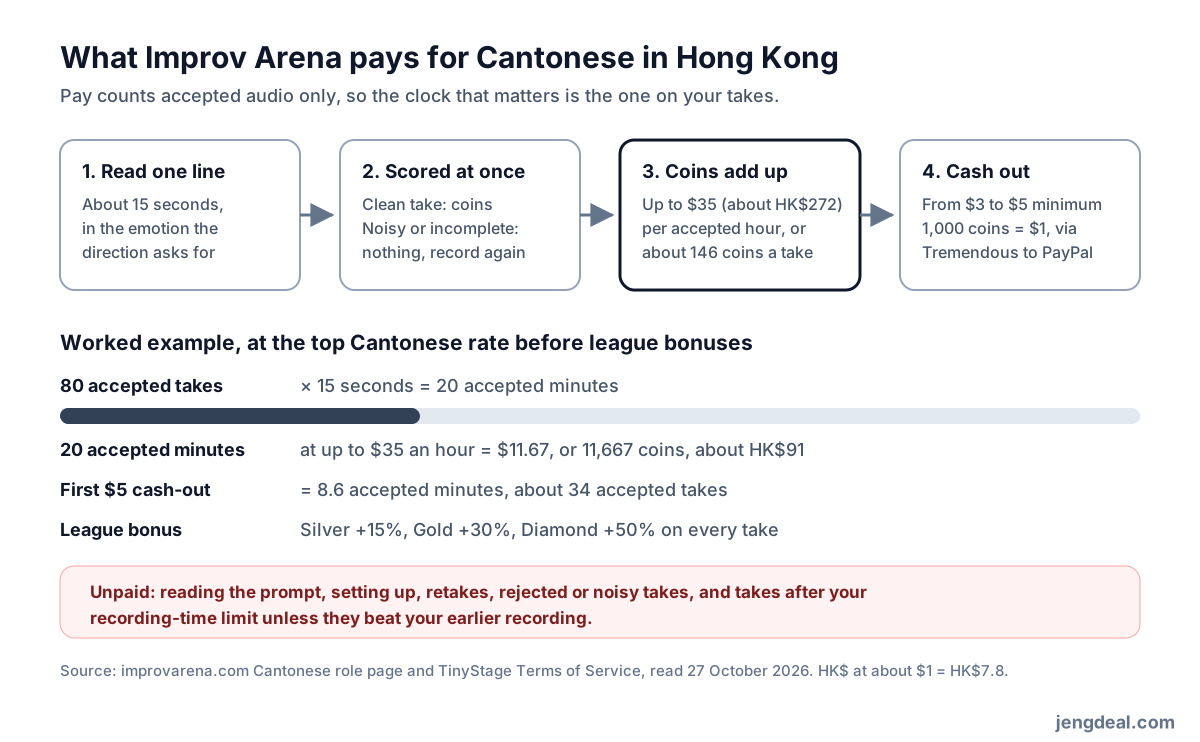
Every role shows an hourly ceiling in US dollars, and that hour only counts accepted audio, not your prep time. The Cantonese role in Hong Kong tops out at US$35; the site converts at the live rate and rounds down, so Hong Kong visitors see about HK$272. Coins are the currency: 1,000 coins = US$1, so a clean 15-second take at the top rate is worth about 146 coins. Pay tracks quality: clean takes earn the most, weaker ones less, and a take that's too noisy or skips words pays nothing and needs a redo.
Two things bump your pay. Leagues add bonus cash to every take: 15% at Silver, 30% at Gold, 50% at Diamond. A pro mic the app confirms (a USB or studio mic on a stand) earns up to 25% more per take than the standard rate. Two things drag it down: once you hit your recording-time limit, new takes only pay if they beat your earlier ones, and how much work there is depends on demand for your language. Improv Arena doesn't say what the limit is.
3. What an hour really pays
At the top Cantonese rate, before league bonuses: 20 accepted minutes is 80 clean 15-second takes and pays US$11.67, about HK$91. Your first US$5 (about HK$39) cash-out needs roughly 8.6 accepted minutes, or about 34 takes. Those are minutes of finished audio, not minutes in your chair.
Around each 15-second take you read the line and direction, record, maybe listen back, and redo the duds. If a third of your session ends up as accepted audio, a full hour at the desk earns about US$11.67, roughly HK$91. The headline rate is handy for comparing languages and pricing a clean take; just don't mistake it for your hourly wage.
4. Who can join: Cantonese means living in Hong Kong
Roles are matched to your native language and where you live. Native Cantonese speaker in Hong Kong? That's the Cantonese role. English roles are for people in the UK, US, Australia, New Zealand, Canada and India, and Taiwanese Mandarin is for people in Taiwan. The site says any language can apply, but it only promises work for the roles it lists. For a sense of scale: British and American English go up to US$40, Japanese US$40, Korean and Taiwanese Mandarin US$35, German in Germany €80, Swiss German CHF 84, and Filipino and Hindi just US$10.
Got a forwarded message saying "up to $1,104 an hour"? Don't get excited yet: the share message uses the sender's local currency, and $1,104 is New Taiwan dollars, about US$35, the Taiwanese Mandarin rate, not US dollars. In Hong Kong, go by the Cantonese role's US$35 (about HK$272).
5. You need a decent mic and a quiet room
You need to be 18+, a native speaker of the role's language, and have a computer or phone online, a quiet room and a mic. The Cantonese role page asks for a USB or studio mic on a stand, like a Blue Yeti or a Shure. Sign-up asks for your best mic: if the app can't confirm a pro one, you can still get in with wired headphones or earphones with an in-line mic, at the standard rate. Laptop mics and Bluetooth earbuds won't pass the pro check, and noise-cancelling apps like Krisp get flagged as virtual mics.
Sign-up takes about 10 minutes, including a three-minute audition: 15 seconds of silence (any noise restarts the count), then two short reads, one "clear and natural" and one "angry and fed up". If the app can't confirm your pro mic straight away, it usually gets back within two days. There's a Traditional Chinese interface. Improv Arena checks age before paying, and some reviewers say a higher voice got them flagged as under 18.
6. The big condition: your voice goes to AI
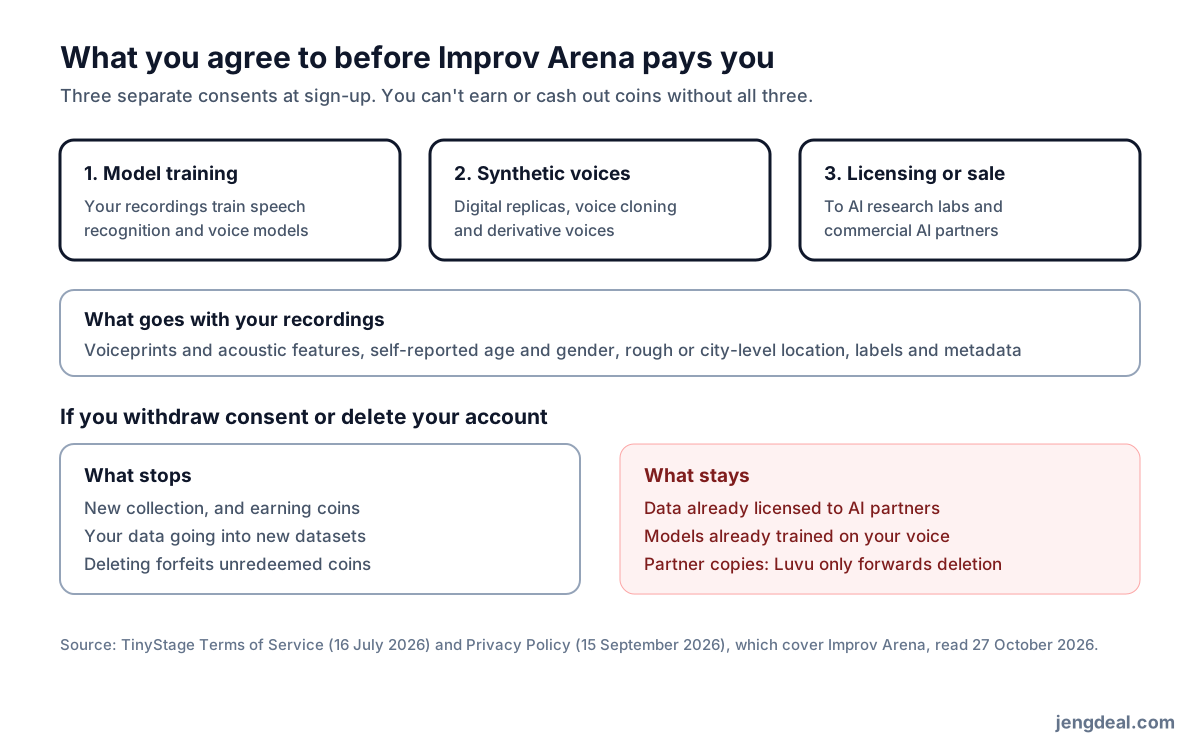
Read this bit properly. At sign-up you tick three separate consents: model training, synthetic voice and Digital Replica use, and licensing or selling your data to AI Partners. The terms make all three a must for paid recording and cashing out. Luvu can license or sell your recordings, voiceprints and derived acoustic features, self-reported age and gender, rough or city-level location, labels and metadata; AI Partners can use them to train speech recognition, text-to-speech, voice cloning, synthetic voices and digital replicas.
You can withdraw consent or delete your account any time. That stops new collection, keeps your recordings out of new datasets and pauses earning. But recordings already licensed to an AI Partner stay licensed, and models already trained on your voice can't be untrained; Luvu only forwards deletion requests to partners where the law or its contract says so. Deleting also wipes any coins you haven't cashed out. Biometric data is destroyed within three years of your last interaction. Your audio also runs through Luvu's processors for transcription and scoring: OpenAI, Google Cloud, Microsoft, Deepgram, ElevenLabs and Hugging Face. Voice actor, or creeped out by a clone of your voice existing? Stop here.
7. No sign-up bonus, and how we earn
Joining through our link gets you a normal account: Improv Arena gives invited users no bonus, so everything you earn comes from your own recordings, ratings and transcriptions. Open the link in the browser you'll sign up on; it saves code 55PNHS and carries it into sign-up. If it asks what brings you here and the code isn't showing, pick the referral code option and type 55PNHS.
Full disclosure: the link and code 55PNHS are our invite. When you cash out money you earned, Improv Arena adds a matching amount to our balance, up to a weekly cap. That comes from Improv Arena, not out of your earnings, and it's why the scheme checks every invited person has a different voice.
8. Cashing out
Once your balance passes the minimum in the app (the terms say US$3 to US$5), request a cash-out in Rewards and enter your email. After Improv Arena approves it, sometimes after checking your recordings, payout service Tremendous emails a link where you choose how to get paid, such as PayPal or a gift card, depending on your country. Everything's in US dollars, so a Hong Kong PayPal account converting to HKD takes PayPal's exchange spread.
Cash out early. A small first cash-out proves payment works for your account and email before you sink hours in, and money that's left the app can't be caught by a later suspension. Type your email carefully; the app flags likely typos.
9. Bans and frozen coins: the top complaint
The terms give Luvu wide room to adjust, hold, revoke or cancel coins and payouts for things like fraud or abuse, automated or AI-generated submissions, manipulation, or the wrong region or age. Only you can record on your account; the app warns that if someone else keeps recording there it may be banned, and banned accounts can't cash out. Coins and scores are decided on Luvu's servers with no formal appeal; the terms follow Pennsylvania law, and disputes start with a written notice to [email protected] and 60 days of informal talks. UK, EU and Swiss users get extra protections; Hong Kong users don't.
On 27 October 2026 TinyStage had 4.3 from 15,733 ratings on Google Play with 100,000+ downloads, 4.7 from 559 on the US App Store, and a single one-star rating on the Hong Kong App Store. The latest written reviews are harsher: 14 of the 24 newest US and UK App Store reviews gave one star. The same complaints keep coming: balances frozen or accounts banned over "multiple voices" or multiple accounts, voices judged under 18, high-scoring takes that paid nothing, cash-outs that took days or never arrived, support that doesn't reply, tasks vanishing behind "coming soon" screens, glitches and lost progress, and pushback on the AI voice licence. Fans say it's fun and does pay, some within minutes of cashing out.
10. Is it for you?
Go for it if you're a native Cantonese speaker in Hong Kong with a USB mic and a quiet room, want a bit of pocket money in spare moments, and you've read and accepted the AI voice licence. It works best for people who enjoy reading lines with feeling and treat it as pocket money, not wages.
Skip it if you're a working or aspiring voice actor, mind a cloned or synthetic version of your voice existing, share your recording space or account, or need steady hourly pay: accepted-audio pay, recording caps and up-and-down work make it no substitute for a job. Under-18s can't play at all.
FAQ
- Is Improv Arena a scam?
- No, it's a real service run by US company Luvu, Inc., and users report getting cash-outs. But what you're selling is your voice: earning means licensing your recordings to AI companies, voice cloning included, and the terms let Luvu hold coins if it suspects fraud.
- Is there a sign-up bonus?
- No. Joining with our link or code 55PNHS gets you a normal account; you earn from accepted recordings, ratings and transcriptions.
- How much can I make reading Cantonese?
- Up to US$35 (about HK$272) per hour of accepted audio, plus 15% to 50% league bonuses. At the top rate, 20 accepted minutes is about US$11.67, roughly HK$91. Prep and failed takes pay nothing.
- Why did a friend's message say up to $1,104 an hour?
- The share message uses the sender's local currency. $1,104 is New Taiwan dollars, about US$35, the rate for Taiwanese Mandarin speakers living in Taiwan.
- What's the link between Improv Arena and TinyStage?
- Improv Arena is the web version of the TinyStage app: same Luvu, Inc., same backend, same terms. TinyStage accounts cash out in the TinyStage app.
- Do I really need a pro mic?
- The Cantonese role asks for a USB or studio mic on a stand. If the app can't confirm one, you can still get in with wired headphones at the standard rate; a confirmed pro mic earns up to 25% more per take.
- Can I record English or Mandarin from Hong Kong?
- English roles are for people in the UK, US, Australia, New Zealand, Canada and India, and Taiwanese Mandarin is for people in Taiwan. You can apply in other languages from Hong Kong, but work isn't promised.
- Can I get my voice back if I change my mind?
- Only partly. Withdrawing consent or deleting your account stops new collection and keeps your recordings out of new datasets, but data already licensed to AI companies, and models trained on it, stay. Deleting also wipes coins you haven't cashed out.